

Hi Guys, I thought the Hudson splasher engines had insert mains, at least from 37 on?

Steve,
The splashies of the era I'm familiar with have a replaceable insert but not in the modern sense of the term. The typical procedure for "renewing" of the mains is to re-Babbitt the removable bearing shell, bore to semi-finish then line-bore them in-situ to achieve precise alignment and location. The bearing shells are a relatively thick, heavy bronze unit (I believe they're Bronze) that could be defined as "inserts" but not in the common sense of the term. This, I presume, was an period appropriate move away from Babbitt poured directly in the block main bores.
Sources for new replacements have all but dried up. I'll be corrected if in err, but I think the only undersize available back in the day was -.010 and that may have only been because some engines were at -.010" from the factory. I imagine that re-Babbitting and line boring was the common method of main brg. repair back then as well......just my guess. Doug will know.
The reference to "Jeep" bearings is only about the rods. I personally know of no one who has converted mains. Possible? Yes, but not worth the $/effort IMO. One could say that about the rods as well.
Get ready for the "align-bore" versus "line-bore" discussion.
F

I think splasher bearings came in .002, then .010. .002 would be more of an in chassis installed part, and the .010 would require machining of the crankshaft. You could get undersized con-rods. When parts were readily available, if you needed anything more than that, you ordered a new crankshaft and bearing assembly. That would be nice to do today! I have seen .005 oversized piston pins too. I'm sure when your engine got undersized bearings, it got the other available wear parts. Something else that was a common practice was knurling. Most machine shops had the equipment to knurl pistons.
I thought Fred Lorenz, OH. had an 8cyl.with a full pressure system. I don't know what was done to obtain that, but I remember looking at it in Rapid City when the hood was up. We traveled with my parents in their '50 C8,the Anderson's in their '48 C8 and our '49 C8 , all overdrive cars.
O.K. Frank, I understand. 2 different types of inserts, one 'slides' in and the other is installed with a flathead machine screw. Nuff said.
Steve,
Welllllll...it's a bit more of a difference than that. Suffice to say that it's pretty much a no-brainer to have the originals re-done. I lucked-out and found a set of new mains @ semi-finish for the project I'm working on but don't expect to have that kind of luck again.
Doug,
I've also heard about the Fred Lorenz pressure lubed Eight and at last report it was running well and had been for over 10 years. That would be a fun project.....expensive, time-consuming, exasperating at times..... but fun.
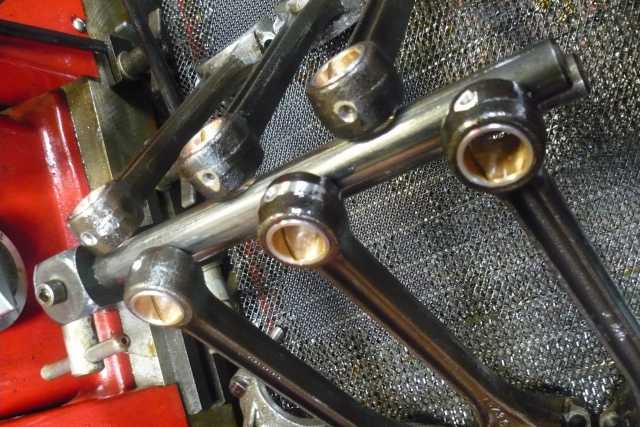
Here are a few photos of my version of the rod mod.
133) Roughing out the "big end" to make room for the inserts, leaving ~.004 for final finish.
135) Milling the tang notch.
139) Milling the oil groove. The original groove is mostly removed by the boring step in 133. This groove serves a slightly different purpose than the original.
141) Rod bolt clearance notch milled in the insert so that questionable bolt modification is unnecessary.
146) Taking the housing bore out to final size/finish. Sizing is critical with a +.0005 to -.0000 tolerance.
147) Rods clipped, bored, notched, grooved and honed to finish.
There's a little more to it but there's a football game on and Patty hates to yell at the TV by herself.
Frank
To continue.......
As you know, if there ain't no pictures, it didn't happen......so:
For those familiar with the Jeep inserts, you'll notice that these aren't. They are Clevite (Mahle) CB179P, spec'd for the Allis Chalmers 116 and 125 inch fours (and others). These were selected for a few reasons: width is roughly equal to the original poured Babbitt Hudson rods @ 1.229"; the bearing material is TM-77, which is a "Tri-Metal" insert having a steel back, Copper intermediate layer and a Lead-based Babbitt overlay wear surface and; they are readily available in Std. + the usual undersizes.
There is a plain, un-grooved version also available (CB 781P). I considered using a combination of the two types, using the un-grooved for the rod (upper, so as to be similar to the Hudson) and the grooved for the lower (cap) but decided to use the grooved in both positions to get some additional flow for cooling.
The groove in the rod cap provides a direct path for oil flow to the two holes in the insert and into the bearing surface grooves you see in pic ***141.
I have an ongoing discussion with the tech guys at Mahle regarding the Lead-based Babbitt overlay as opposed to the Tin-based material specified for poured Babbitt bearing work by most manufacturers of those bearing alloys. Details on the half hour.......
Frank
Excellent work Frank !. I would be curious to how much weight difference there is before and after. I think that after your finished, it would only be a performance enhancer!
Doug,
There's virtually no change in weight since the material removed to "make room" for the insert is replaced by the insert itself.
Needless to say, this operation is followed by installation of gudgeon pin bushings, honing, de-mag and straightening.
The fixture in ***133 serves to hold the rod for boring (of course) but also establishes the C-C length and centers the big-end bore between the rod bolt holes. Hudson was a bit sloppy on both of the latter details and rods that have been rebuilt previously may be worse yet. A set of special rod bolts are used to clear the bore while this job and the final honing are done.
The boring fixture has two locations for the "little end" expandable spud to accommodate the 175 8-5/8" long rods as well as the 212/254 rods.
I'd not recommend this mod for the pre-'39 rods. If you have one of those, I'd replace them with the later version.
Frank
Are you still honing the pins .0000-.0003, or setting them up a little looser?. That alone is very important, which most machine shops don't believe to be correct. Are the rod bolts something you are getting standard, universal, or do they fit some other application?. ARP had something I thought would work, but I have never spent the time to do that. I'm glad to see your work. I would expect your attention to detail in doing this will turn out great. thanks for spending the time and sharing it with us.
Doug,
I'm still adhering to the .0000 to.0003 clearance, typically holding it toward the tight side. .....I didn't know of any problem with that technique. I do, however, add an oil hole at the top of the rod. It likely does very little but it just seems right, and I see that Hudson used it in the Jet/Wasp 202.
So far I've just used "select" used rod bolts/nuts. Any defects are cause for rejection. I'd not be surprised if ARP has something far superior but rod bolt failure hasn't been an issue as long as I've known. I would, however, like to ID a suitable replacement......they can't be stressed an infinite number of times and I will eventually run out of good ones. I think I arrived at a Y Block Ford bolt at some time in the past, but I'd need to revisit that search.

As someone who has made insert conversions for many old engines,
I can share this--modern insert bearings are harder than babbitt and have much less ability to imbed particles and junk circulated in the oil. With the old high imbedibility soft babbitt, crankshafts were not heat treated or surface hardened. When we do a conversion we have learned the hard way to nitride the crank to toughen the surface. If one is lucky enough to find old construction lead-indium surfaced bearing shells, you have a better situation. The aluminum surface bearings common today require a hardened crank and Frank Hughes oil filtration for longevity.
And a little more: The are tricks to getting oil flow to cool the bearings as Frank has suggested is imperative. The crush of the babbitted inserts in the housing is also essential to this. Done properly, there is nothing inferior in babbitt bearings even in hard use. We build babbitt racing engines with superchargers, methanol fuel, and high RPM with good reliability.
As for Kelly Hinegardner, he hard chromed the rod journals to use the jet bearings in his Hudson 8 rods. Same for Gus Souza who found this the solution with his drag race 8s.

Somehow I missed this topic before, so here is my two cents worth. I have converted four Essex motors and one Hudson 8 to shell bearings over the years, both main and connecting rods, and none of them have worked out in the long term. In all cases extreme wear of the crankshaft resulted. I used Continental C4 rod inserts, with plenty of oil grooving, and correct crush, and they work for a while, but in the end the crank will wear much more than with poured babbit. The longest lasting one was a 1930 H 8 which did around 15,000 miles before the connecting rods were knocking, and when measured the journals were worn .008". With a poured bearing you would expect no crankshaft wear at that mileage. I used Hillman Hunter Main bearing shells, and again, this resulted in major crank wear after a few thousand miles. I would be interested to hear from anyone who has converted to shells as to how many miles their engines have done since conversion. I have been there, and found it not worth the effort and expense. However, the other side of the coin is getting someone who can do good re-metalling of bearings, as I have had a number of bearings fail, not through wear but by falling apart. we are truly caught between a rock and a hard place!
Geoff
As I said previously, using inserts and no filtration requires a nitrided or hard chromed journal crank to give any service life. If one were fortunate enough to have "old school" Vandervell VP2 tri-metyal bearing inserts, the material has a soft surface layer with significantly more imbedability than modern aluminum bearings. We have done insert conversions on many engines but always with a treatment to the crank. This was learned the hard way after experience like Geoff's.
Ivan
I'd expect the nitriding process to be expensive and not readily available to the average builder, adding yet another element of cost to he idea. Ivan's and Geoff's comment that these cranks are relatively soft and subject to premature wear brings me to this question: The typical modern, non high-performance engine has neither a chromed nor nitrided crank and uses the typical Aluminum faced bearing insert, so are you saying that filtration (as is a standard feature in any modern engine) is the sole key to a successful conversion? (assuming, of course, that the conversion job was done correctly).
A true Full-flow set-up is an impossibility in the Hudson splasher engines but it is possible.....even practical, to have intervening filters in both the front and rear oil delivery circuits in those engines. This set-up provides filtered oil to the dipper tray but oil may be recirculated in the upper cavity of the crankcase many times before finding its way back to the reservoir, thus allowing it to become contaminated to some degree before it is once again passed through the filter(s). Pretty much the best we can do in the "Splashers".
F
