

Only had the Hornet a week but found a 160 degree thermostat that I want to change to a 180. I note the bypass opening in front of the thermostat but what I can't yet understand is all the stuff within the thermostat housing--stainless steel disk with a pin hole, etc. Most housings I see are plain no obstructions. NOW, should any modifications be made to get maximum cooling. I have a Griffin Aluminum radiator, 6 blade fan, and Vintage Air Conditioning and just want to do the most efficient thing. Anyone with a suggestion. Thank you so much.
Richard

I do not know the answer to the configuration, however I have a question for you. How hot is your Hudson running. I have the same engine and it had a 180* thermostat and it was running 200+ degrees. I had to get a 160* thermostat to get it to run @ 180* w/o the AC ON. Do you really want to change the thermostat??

Moved to "Hudson" sub-forum
Car not running hot; a 160 degree thermostat has nothing to do with the car running 180 degrees; the thermostat will be all the way open at 160 degrees. I do not want the thermostat to open all the way until 180 degrees. Higher engine effiency at 180 not 160. This is the first car that I have ever seen/had that recommends 160; but I will change to 180 as soon as I can get a thermostat. Now it might go to 200 I don't know--it is 14 degrees here now--A/C is not being operated in the week that I have had the car. Maybe this car is different--time will tell.
Thanks~~
EDIT: noted that I did say maximum cooling; I also meant maximum heating and I am not sure that 160 is warm enough.
Here is the inside of the thermostat housing as seen from the thermostat. I didn't realize how it worked. That the bypass opening(water from the block goes to the radiator when the thermostat is closed) shown here at the top goes into the casting and then goes 'backward' to come out the extremely small hole in a 32 mm diameter stainless plate,then turns around again to go to the radiator. Unusual to a 'new comer'. I am used to bypasses being larger--like the curved rubber hoses on V-8 blocks. Don't suppose it matters unless the members think the small hole should be enlarged some (a large piece of rust would stop it up !!). Thanks for the help; does anyone have a good reason NOT to go to a 180 degree thermostat.
Richard
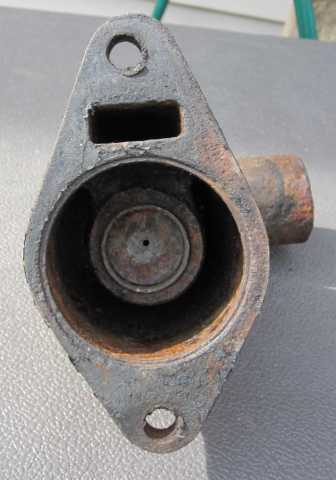
I am a little out of my comfort zone here, 'cause I have a "prehistoric" (pre-StepDown) Hudson. But, somehow that thermostat housing (or water outlet, or whatever) doesn't look right, with the tiny hole up inside.
I too have a bypass type arrangement, on my '37, and do not recall that little hole. I wonder if someone stuck a round plate in there and drilled the hole, to restrict the flow, at some point? Maybe it was "factory"....I dunno....
The bypass style thermostat should look like this -- does yours?
[img]  [/img]
Here is another one, with a diagram of the thermostat housing behind it:
[img]  [/img]
(The above images are currently on Ebay and may "go away" before long.)
If you do need one of these thermostats, Ebay is a good place to look, but frankly I wouldn't pay much more than $5 apiece. They will fit all sorts of cars, thus they're not particularly scarce and valuable. Do test yours in a pot of boiling water, before installing it...and always pack a "spare" in the trunk.
With any luck, a StepDown Specialist will come along and give you a more educated answer. (I'm surprised that one hasn't arrived here already!) I'm just raising a yellow flag....
That is why I posted a photo of it, to see if the stepdown guys recognize. As I said I have only had a Hudson a week. Thought it strange to see "32mm" stamped on the stainless steel--the outer diameter. ALSO, I have come to a conclusion why the small hole is there: the bypass water will be directed onto the thermostat element {in the center} so as to activate the thermostat accurately. I will enlarge the hole slightly but that is all. As far as castings that bypass the radiator: I have not see that. The bypass water goes to the radiator regardless. Will get my dental mirrors and check, but I cannot envision a shrouded thermostat needed. My Austin Healey 3000 is like that and uses a shrouded one(or should--expensive !!) so I know what to check for. Thanks for putting-up with me thus far ~~~

MY 53 HAS A 56 ENGINE WITH NO BYPASS. THE GOOSENECK IS OPEN AND ALLOWS NO SIDE BYPASS. THE ENGINE RAN COOL WHEN I GOT THE CAR. I AM GLAD I DID AN OVERHAUL AS THE BRASS WATER DISTRUBUTION TUBE HAD MUCH CONTAMINATION. IF YOUR UNSURE OF HOW CLEAN YOUR BLOCK IS I WOULD RECOMEND CLEANING THIS TUBE. MIGHT BE OVERKILL BUT THEN?
I am beginning to wonder if I have it backwards; the water flows thru the thermostat; goes thru the little hole, then back thru the 'bypass' cast hole in the block to the water pump. Wonder if anyone has made the thermostat gasket solid to cover up the pump bypass and what the results were. Did the car take somewhat longer to warm-up?? Did ALL the water going from the block, thru the thermostat,go to the top of the radiator?? If that was done,would a shrouding thermostat be necessary(which I think would allow bypass to warm up engine and also allow full radiator recirculation during normal temperature operation). Would really like to know this? Thanks
Your thermostat housing, best as I can tell, has been modified to limit the water through the bypass. The original bellows type thermostats would close off the bypass passage when the thermostat opened. New thermostats do not operate like this, leaving the bypass open even when hot. To counter this, the bypass needs to be blocked - either in the housing or gasket - the hole allows a bit of coolant to circulate when closed. I run a custom gasket to block my bypass, with a 1/8" hole. Works good for me.
Tks; believe then with the 1/16" hole like is in the stainless plate the bypass should run at a minimum and should not be something I should concern about. Am I correct that the water is sucked in the small hole and then is pulled to the pump to bypass the radiator.
Your bypass-type thermostat housing has had its bypass plugged with a freeze plug into which an 1/8" hole has been drilled, similar to this housing:
[center][img]  [/img][/center]
This was done by a former owner in order to use one of the "modern" (non-bypass-type) thermostats. The modern thermostats are not tall enough to close off the bypass opening, so he elected to close off the opening himself, with the freeze plug. Possibly he could not obtain the correct "bypass" thermostat (of which I posted a photo earlier in this discussion). Or he may have had another reason.
As for myself, I simply found the bypass thermostats and keep a few spares just in case, and thus I don't get into having to modify things.

Richard, I think you may be interpreting what you're seeing incorrectly. When the thermostat is "closed" (cold), coolant circulates through the block but doesn't go to the radiator. When the thermostat is open, the coolant is routed to the radiator. As for the tiny hole, folks drill that hole to prevent a vacuum when you drain the system, and helps to avoid air pockets when you're filling the system. Most thermostats have a tiny hole in them for this reason.
Thanks all for the replies. This arrangement was something new to me and I wanted a complete understanding. Now I have it.
I will post photos (new thread) of the water pump pulley that caused me to drain all the water out and look at the 'stat for curiosity while replacing.
It is not good--the metal is almost thin as 5 sheets of paper and it is stock Hudson.

The gentleman to talk to about this is Walt Mordenti
Hudsonly
Alex B
