

Hi, everyone. I've got my '51 Pacemaker pretty much back together, but have run into an interesting problem. I have installed a new clutch disk (from Wildrick) and I promise I'm only using one gasket between the pressure plate and flywheel, but I've backed the factory adjustment off as far as I can (I backed it off until the yoke fell off, then screwed it back on 360 degrees and tightened the lock nut) but the clutch is still very low, and when the car gets fully hot the clutch doesn't fully release, making it stiff to shift and challenging to get into 1st when stopped. I was wondering a couple of things: 1) Has anyone else had to deal with this? 2) If so, how did you address it? 3) I noticed that the arm that the yoke attaches to is held onto the shaft by a pinch bolt, and was wondering if it was possible/advisable to rotate the arm on that shaft by a notch to create more throw for the clutch pedal.
As always, I appreciate all thoughts, suggestions and input!

John, what all did you replace on your clutch?. If you replaced just the clutch disc, it is very possible the pressure plate was out of specs. Did you check the installed finger height as described in the shop manual?. The 1. 250 to 1.500 minimum /maximum finger depth is crucial,. Also, did you replaced the clutch linkage cushions?. If these are gone, it can add to the lack of adjustability.
I did not replace or adjust the pressure plate, so it is possible that it's out of spec (nor did I check the finger height). I did order from you and install the linkage cushions, as they were completely absent (it took me a few moments to even figure out what they were or where they were intended to go!) Although it's possible that the pressure plate is not right, the clutch is engaging smoothly and I didn't see any worrisome signs of wear on the face of the pressure plate or the flywheel -- I know I should have had them turned/replaced, but the local shop I trusted with such work closed in 2017 (and the flywheel is pretty thin to begin with -- I don't love the idea of removing material!) I ended up cutting a bolt in half and just using the threads, which I attached to the end of the original threads from the top yoke with a coupling nut. This extended my threads quite a ways, but I only needed about 1/4" of it. The clutch now engages at about the halfway point of the pedal travel cold, closer to 1/3 of the way off the floor when hot. Once the clutch wears down some and needs adjustment I should be able to remove the extension and be back to stock.
Thanks for taking the time to answer. I will bear your questions in mind, and if I find myself back inside the bellhousing at some point I'll make a more detailed inspection of the pressure plate! It's nice to know where to look if I'm not ultimately okay with my current solution!

My post includes a jpg that describes how both ends of the clutch linkage MUST be supported. If this is not as described it TOO will interfere with proper clutch adjustment. The clutch shaft repair information can be found on my website in the clutch section.
[url= https://hudsonrestoration1948-54.com/ ]Ken Cates Hudson Stepdown Restoration Resources[/url]
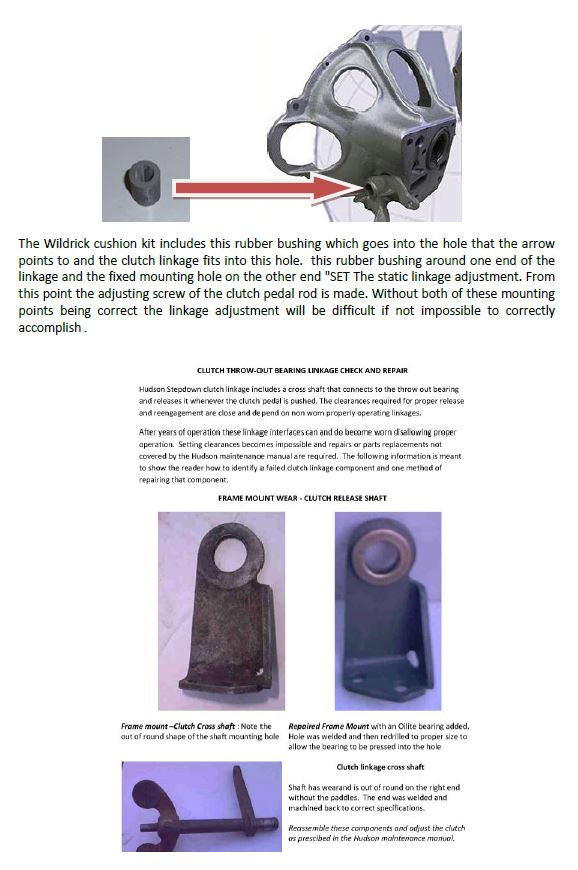
That's great info Ken, and as always, your website has helped countless Hudsonites! I think something you should add on your website about this. Something that gets over-looked is checking the bell-housing cross-shaft for wear. I think 9 times out of 10 the shaft will have excessive wear. Excessive wear can cause clutch adjustment issues and can also cause clutch chatter. I think you have my clutch chatter check sheet posted?.
When it comes to the bell cross-shaft- there are 3 thin bronze bushings the shaft pivots on. These bushings are usually worn badly on one side, along with the actual shaft with wear in the same place the bushings made contact.. The combination of bushings and shaft worn badly allow the shaft to float loosely, and cause excessive play. That play can not be adjusted out. You can over-tighten the adjustment clevis, but the bushings and wear are still there. When the bushings and shaft are worn out, the yoke makes contact with the throw-out bearing and as the pedal is depressed , it has to take up all the play, thus actually depresses the t-bearing at an offset angle.
So with the engine running, when you depress the clutch pedal, it applies pressure un-even against the fingers. Applying the fingers un-even and the engine running makes the fingers wobble, for better description, and cause chatter. The chatter is because the pressure plate is applying against the clutch disc un-even, so as it engages and compresses the flywheel, the disc only contacts a portion of the flywh., then when you release it completely, it works fine, no more issue.
*** - A quick check of bell-housing cross-shaft wear. With no tension or very little tension applied[depressing the clutch pedal] take hold of the bell-crank on the outside of the bell, check for vertical and horizontal movement. A slight movement is somewhat normal , but any more than usually is a result in bushings and excessive shaft wear.
I hope this isn't too confusing. This is something the shop manuals really don't talk about, but they also don't say add 65 plus years!
Doug thanks for the comment and suggestion. I am in the process of creating a document to post on my website which will combine the linkage and bell housing aspects of proper clutch operation.
Thank you, Ken. Apparently there's quite a bit that can cause problems in this system!
The clutch document was created and is now posted on my website.

Thanks for all the information, Ken (and Doug). Just yesterday it went out of adjustment again -- I'm barely getting any resistance from the pressure plate when the clutch pedal is floored and it's no longer fully disengaging the clutch. Got a friend to operate the pedal while I checked underneath -- I now have a significant gap between the paddles for the cross shaft and the paddles for the pedal linkage, whereas I was extremely tight on that adjustment before. Can't lengthen my rod any further, as the z-bar is now touching the floorpan when the pedal is fully depressed, but I'm not really seeing any play in the linkage, so it looks like it's inside the bellhousing (which is not visibly cracked, I just checked in response to the information you sent, Ken). My guess is that the pins that attach the throwout forks to the cross shaft are bent/shearing, or possible the forks themselves are bending. Won't know until I pull the whole shebang back out, I suppose, but I'll keep y'all posted. Again, thanks to all for the help!
