

Just wondering what the correct setting g is for the heat control spring. Want to be sure it is not too tight. With a hot motor it is closed at idle but does swing open as you increase the revs. Thought it may have been open at idle on a hot motor.
Also the safety plug has blown out a couple of times and I have just put back with a smear of exhaust sealant.
Thanks in advance for your help.
Alistair
NZHET 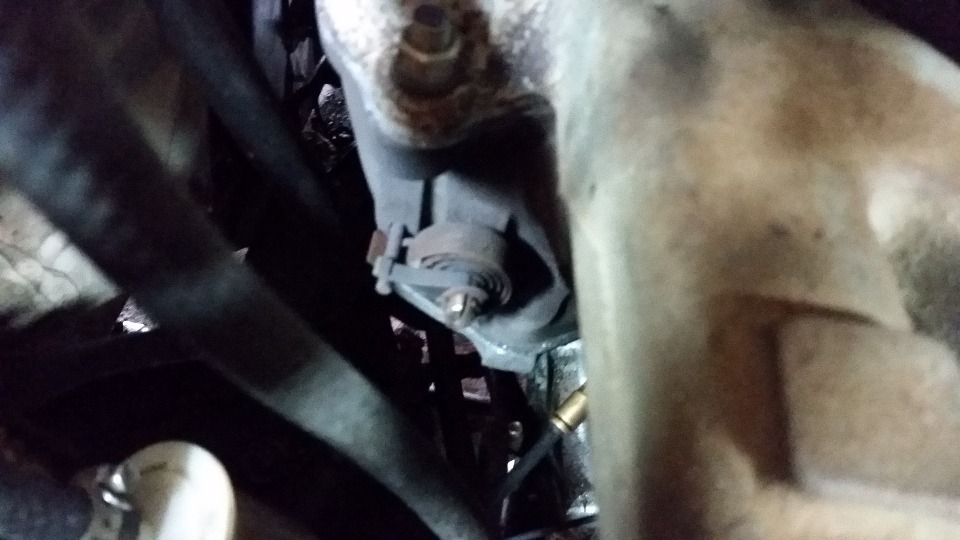

Topic moved to "Hudson" forum category
Topic moved to "Hudson" forum category

Those springs are a bimetallic spring sensitive to temperature. My impression is that many quit working properly after some time. Note sure if there are replacements out there. Many people simply use a wire to hold the butterfly valve open (the part the spring moves inside the exhaust line).
Thanks Tim.

As Tim pointed out, wire it open. This works fine . We usually remove them completely. The bushings in the shaft are usually worn out and is an exhaust leak. An exhaust leak under the hood adds extra, unwanted heat, and also lets fresh outside oxygenated air suck in when the throttle plate is closed and the car is de-accelerating. This in turn allows the manifold to get extra hot, and can cause it to crack and warp. Cracked manifolds are very common, and when we see them cracked badly, the heat riser is usually worn out very bad!, so... The extra heat also cuts engine performance. Something else that always gets overlooked is cleaning out the exhaust passages inside the manifolds. This too creates performance issues, especially with Twin-H power set up. You can remove the lower exhaust elbow, use a die grinder and remove the heater riser shaft, put torque prevailing nuts and bolts in the place of the worn out holes of the shaft.. When all done, it is much quieter under the hood, and the extra, unwanted heat is gone. Cleaning inside the manifolds allows the exhaust to circulate inside, which believe it or not, lets the exhaust cool better, and lessens the chances of the carb/ carbs boiling over when the engine is shut off after running for awhile. Modern fuel is really designed to be injected, not carbuerated . Anything that can help these concerns should be implemented.
Thanks Doug. I really appreciate your input. With what I have received from you, Tim and guru Geoff I have a small project to do.
Being RHD it is not as easy for us to do things in this area - steering box, pedals and other linkages like throttle to deal with before you start!
Replaced the manifold gasket earlier this month and took all day from wo to go - another one for Geoff's Flat Rate Manual comparison!
I was prompted to look at my manifold when the aluminum intake popped a plug and then the car sounded terrible when running. The plug was on the aluminum intake, and it is in the chamber just below where the carb sits and is to warm the carb/fuel area when the car is cold started (warmer exhaust circulates in this area). Once I took that apart and looked a bit, I realized someone had put the spring on the butterfly valve on backwards, so it was keeping it closed all the time, so I took the entire manifold off. Many warned me not to do that, because of the brittle studs that might break off and complicate the repair, but I soaked the nuts with penetrant and they came off with no problem. Except the ones toward the firewall on the bottom are very hard to reach! i have long arms, and was barely able to get to them, but the biggest issue was getting the tools where they need to be and getting some torque. I took the manifold parts in and had them carefully planed (some of the gaskets were in poor shape), replaced the gaskets and the plug, and reassembled and it works great. I tested the spring on the butterfly valve, which did move freely and it had stopped working. I discussed with Frank Hughes before he passed, and was considering buying a new spring, but haven't followed up on that and instead just wired the thing open. Clearly, I would do what Doug suggests and eliminate all future potential problems. Most of us don't drive these cars in very cold weather anyway, and there's little need for this feature with fuels of today anyway since they do burn hotter and overall may help lower the issue of fuel icing. THe bigger problem, as Doug says, is heat buildup under the hood. These engines do burn hot. So for my other stepdowns, if I take apart the engines, i'm going to remove the butterfly valve altogether and do as he suggests. Your situation is complicated by the steering gear creating much less space to get at all these. You need a man with rubber arms to get at it. Good luck!
Rubber arms are needed for sure plus rubber tools for some parts!!!
Allistair, I think we need a picture of Geoff upside down in the engine compartment, with a caption saying something like " The flat rate manual sez this only takes 1.6 hrs. "! I'm sure Audio would also be comical !!
Indeed!

I'm working on it! F.Y.I., a further complication of the r.h.d. set-up is that the exhaust outlet is a special casting that finishes up bringing the outlet at right angles to the motor, so that instead of the pipe angling down and under the cross member, the pipe parallels the motor, just below the line of the tappet covers, and then angles down between the bell housing and the clutch and brake mechanisms, hence making hot adjustment of the tappets even more hazardous. And that's the Step downs. Jets are even more complicated. I did an article on this a few years ago.
Geoff
Update - so this afternoon, after much pondering of the mechanism and spring action, I took the spring off and turned it over and rotated 180 degrees before reinstalling it. The slight pressure of the spring now keeps the flap open - please comment if this is not a wise move. I have also tied the counterweight down with fine wire so will see how that all goes now.
Thanks again to all for your input.
Looks nicer than my wire I bet!
That is a good fix. I would like to see pictures of the right hand drive manifold set up Geoff described. I have never seen one before.
