

At the risk of starting a spat, what oil do you use/ recommend using in a 212 that has just been rebuilt
?

Use a good grade of 10-30 syn- tec oil. This is not the old days. Change oil by mileage, 1,000 miles or at least twice a year if yo do not drive it that much. Walt.

[quote="Gordon Eatley" post=17112]At the risk of starting a spat, what oil do you use/ recommend using in a 212 that has just been rebuilt
?
I would use a cheap 10W30 oil for the first 100 miles drain to remove any contaminates then switch over to a good API SN 10W30 conventional oil. There is no need for synthetic. You could get an oil analysis from Blackstone labs if you would like to see how your engine is breaking in.

Depends on how much you love your Hudson; think you could break-in for the first 100 or so, but wouldn't go against what WALT has to say--lot of experience to back up his comments.
Use Amzoil, Mobil 1, or something, but note the viscosity: 10 W 30, not 5w10 or such. You have a 'new' engine; keep it 'new'.
Looks like the consensus is 10W30.
And its up to the individual to choice synthetic or not, I prefer the synthetic oil in my late models. Will do the initial oil change at around 100 to 200 miles to get rid of any rebuilt left overs then every 1000 to 1500 miles or every six month. Hope to drive it at least a few thousand a year.
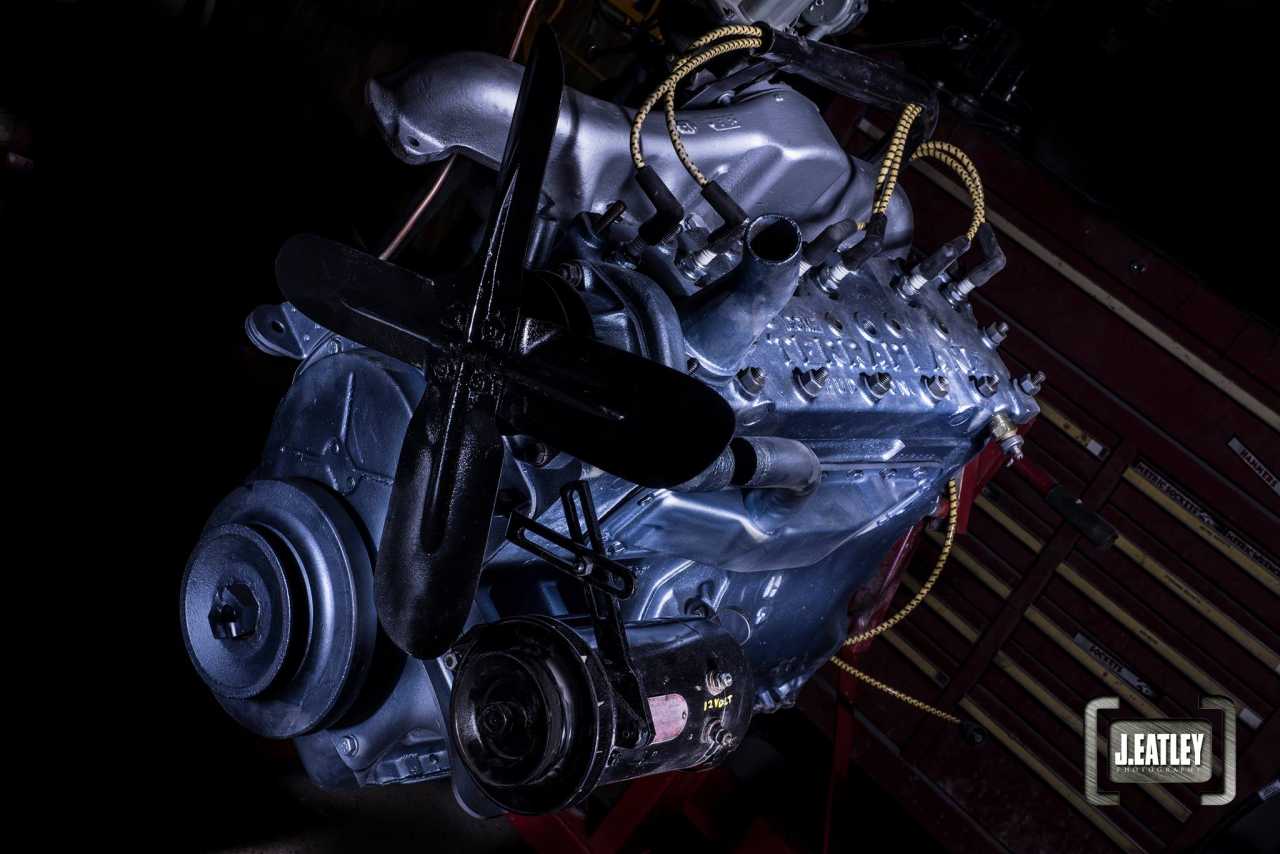
Heres a photo of my engine my son took.
What do you guys think about using Mobil Delvac 1300 15W-40? I am using that now in my '42. Some science says that is the one to use because it is good for flat tappet lubrication. I just can't see using cheap oil in an engine you've just spent thousands of dollars on to rebuild.. IMHO

[color=#ff0000]"At the risk of starting a spat....."[/color]
G,
Any question regarding what oil to use is an automatic invitation to heated "discussion". The designation of multi-grade oils is largely, if not exclusively, a reference to its ability to maintain its viscosity, within a range, over a wide variation in temperatures. A 30wt behaves acceptably within a certain range of temps (probably most encountered in ordinary conditions) while a 10-30 will maintain specified viscosity over a wider range.
In my heavily biased opinion, A greater consideration during "break-in" is the removal of suspended particulates at [i]all[/i] times, and [i]especially[/i] during the break-in period, since a greater amount of such undesirable materials are generated then......that's why it's called "break-in".
The majority of engines designed/produced prior to the mid-fifties, Hudson included, didn't incorporate full-flow oil filtration devices largely because the full flow element wasn't yet in common use. Particulate removal was heavily dependent on separation by precipitation, or "settling-out", of the higher density particles. The typical contemporary oil, regardless of viscosity, contains proprietary additive packages that include (among others) compounds to maintain those contaminants in suspension......not a good thing when it comes to separating them out by settling. Why? Because the "modern" engine is designed and built with a full-flow oil filtration system that removes contaminants [i]before[/i] re-introducing the oil to the oil gallery for the next round of circulation. Continuous re-circulation of contaminated oil is a guarantee of accelerated wear during the break-in period and beyond.
Obviously, the "Splasher" engines aren't as adaptable to an efficient filtration system but the pressure lubricated Hudsons certainly are. I won't even start a fresh rebuild without such a system in place. It's just common sense. As to which brand/weight of oil to use, I'm stayin' out of that one.
Frank
What system would you use on the 212 splasher to filter the oil.
Before you get ready to start your engine, make sure the upper tray is full of oil, and you have the oil pump primed. When I do a splasher and the engine is in the car, remove the valve tappet covers and pour 1 quart of oil in the front and rear area's. This primes the mains. Then remove spark plugs and spin engine to get all rods oiled. Don't worry about an oil filter as your lower pan should have the sump area screened and this cleans the oil to be picked up. You have to remove the oil pan every 5,000 miles to clean and make sure you fill top tray before installing. Walt.
This might help to understand motor oil.
[url=http://] http://www.api.org/certification-programs/engine-oil-diesel-exhaust-fluid/~/media/Files/Certification/Engine-Oil-Diesel/Publications/Engine-Oil-Guide-2010-120210.ashx [/url]
The cheapest SN certified oil is many times better than oil used when Hudsons were new.
Very believable. No doubt, oils are far superior to those from "back in the day".
In regard to the splashers, it's true that there is a 40 mesh screen in the center "box" from whence the oil is picked up......until the screen becomes restricted by crud and the oil simply passes over the top of the box......unless the screen has been punched full of holes (seen that many times!) or the bottom is corroded away from being submerged in acidic sludge for the last 60-70 + years.
A 40 mesh screen is roughly equivalent to a 470 micron filter....about 20 times more "open" than the typical 20-25 micron spin-on used in the common full-flow filter systems of today. I don't know about you, but if I had just spent 4 or 5 thousand bucks on the rebuild of my splasher six (more if it's an eight) I'd feel much better driving down the road, "breaking-in" my new engine, if I knew my oil was passing through a 25 micron filter before being dumped into the dipper tray. It just makes sense to me. Not perfect since that oil is recirculated in the upper crankcase area many times before it finds its way back to the sump for another trip through the engine.......but better than nothing......much better.
Frank

Frank
Do you have any experience/comments on fitting a full flow oil filter system onto an Essex Super 6 splasher engine?
Thanks
Dave Young
Dave,
No, but I'd guess it's a situation similar to the later splashie sixes. I'll do some "research" and offer an opinion soon. I have lots of those in reserve.
Frank
All splasher engines have about 3 to 6 pounds oil pressure. The oil pump sends oil to the front then the rear with each cycle. Not enough for a modern filter. Hudson made a filter to the rear connection and we use to remove it. With todays modern oil and keep the screen clean by dropping the pan once a year you will have no problems. If screen is broken or gone, solder in a new screen and enjoy the ride. I've done many. Walt.
An FYI:
I have run a Hudson Duo-Flow pump on a test apparatus (see photos) up to 50 psi. which it achieves quite easily. It's a myth that the pump is a low pressure device. It is true that the splashers are a low pressure system......more accurately a [i]no pressure[/i] system. The 4-12 psi figure specified in the books has nothing to do with capability of the pump but instead, is a figure representing the pressure in the rear circuit for the purpose of extinguishing the "OIL" light. Once past the "check valve", there is no system to pressurize. It simply gets discharged into the dipper tray. The front circuit has no such pressure generating device since it doesn't need one.....there's no oil light switch to energize there.
Too bad I didn't take a photo when the test gauges were at 50 psi., so you'll have to take my word for it. The apparatus is set up so that one reading is before the white NAPA filter (in terms of flow direction) and the inverted 1516 is there to mitigate pressure "spikes" due to the pulsing effect of the oscillating piston pump. The second gauge is there to show pressure loss through the first filter element.....of which there was none of significance.
The pump was driven at a speed equal to about 1000 engine rpm (~83 rpm).
The intent of the test was to show that the Dou-Flow pump is quite capable of generating the pressure necessary to overcome the minimal resistance created by passing oil through a full-flow type filter element and easily capable of overcoming the internal relief valve in the typical Ford spin-on element at about 12 psi, thus assuring that even a 100% restricted filter would pose no danger to the lubrication system. At 7-10 GPM flow rating (for a PH8-A or equal, and many others), and .687 gpm pump output at 4000 engine rpm (per end) it's not likely that one of us would ever see that scenario in practice.
Enjoy..........
Frank
