

Ok so I have scoured the internet. Some say have the bearing pressed on by a machine shop. The book says heat the bearing to 180 degrees and put on with a light blow. Another says put bearing on shaft and drop axle onto butt from shoulder height onto piece of wood.
Which is best in your opinion? I don't want to screw this up considering how much these things cost.
Thanks you all!
-Ray

I press them on with a hydraulic press. Be sure you're pressing the inner race, not the outer.

Let's be sure we're talking about the right bearing!
You use a press to install the 25877, which is a conventional [i]straight bore[/i] bearing. These were used on the later Spicer built axles that have a straight, cylindrical surface on the axle for the bearing and a shoulder where it seats. The 25877[i][b]-T[/b][/i] is a tapered bore bearing (hence the -T) that must not be pressed on or you risk exploding the cone. That could be far more expensive that just ruining a bearing. It could cost you an eye. Either of the methods Ray described (heat and/or shock) may be used. They "seat" on the taper.
Frank
Yup 25877[b]T[/b]
Frank because of your warning in your email and the more I looked at it the more I thought about it. I then checked out the procedures manual and the forums and found those three procedures recommended in various places online and in the book. My local napa machine shop guy has a dial indicator I can use if I bring the axle down there so I got that aspect covered. Might go the "heat the bearing to 180 degrees and seat with a 2 pound light blow" route. Can't be all that wrong if it's in the book.
Thanks Park and Frank... just got to convince the wife to let me use the oven... or wait till she's not home 🙂
-Ray
Ray,
Taking the axle to a machine shop will not help in setting up the end play when you re-install. That's a procedure that you must do when installing the axles into the housing. "The Book" covers that procedure pretty thoroughly as well. As I recall it, the end play should be .000 to .004", but read the MPM for more info. No point in me re-hashing it here.
I must correct my earlier mssg where I said "and/or" heating. Don't do both. Heating expands the cone presumably to a point equal to the Hammer Method, so doing both could be too much. Good luck.
Frank

Best method is to just fit it over the axle and tap into place with a hammer. This is enough to seat it. That's how I do my '28 Essex, and it has done half a million miles without any problem in this area. A tapered bearing is a tapered bearing! Heating it will not do anything except make it harder to get off. My two bob's worth!
Geoff
The term "tapered roller bearing" is a reference to the tapered rollers. The 25877-[i]T[/i] has a tapered bore as well, which is where the expensive difference is.
I've not used the heat method but I assume that the 180 degree pre-heat with "light, 2lb hammer blow" is deemed to produce the same effect as the "axle drop" method. I, too, have simply given them a mildly authoritative whack at room temperature with good results.
The weight of the vehicle on both tapers tends to keep it seated so there's no likelihood of ever coming loose.
Bottom line: I think all of those methods are acceptable with common sense added. The gist of it is, don't use a press to install a -T bearing.
F

I agree with Frank and Geoff. Heating the bearing will make it expand, which will make it seat slightly further down on the axle, but when it cools, it would be very difficult removing it (when the time comes) w/o re-heating it and what have you really gained? Nothing, seated, is seated whether you heat it or not. If the shaft is cylindrical, heating makes a big difference, as many times you can literally situate the bearing with very little effort and then when it cools, it shrinks up nice and tight (w/o having to press it on).
That's how they used to put the "tires" on the old steam locomotives. They would heat them up, bang them one with sledgehammers and when they cooled, no other fasteners were needed, they just just shrunk to the wheel and were incredibly tight.
While we're at it, let's not forget shrinking a ring gear onto a flywheel. If heated sufficiently, it will drop right on.....no hammers necessary nor advisable.
Yikes! Guess it's been too long since I've worked with the pre-Dana axle. Mea culpa.

I have to relate a story about these 25877T bearings. I once installed new bearings on a '51 Commodore because the originals were damaged due to the car being driven for some time with a busted thrust block in the differential. I decided to use the "drop the axle shaft onto a block of wood" method to seat the bearings on the taper. The bearing seemed seated as I could not pull them off by hand, trying as hard as I could. So I installed the axle shafts and found I now had insufficient end play, as in the bearings were getting loaded as I tightened the bearing retainer cap bolts. So I installed more shims to get the end play about .002" per side. Fine and dandy! I next installed a new left front brake line, which necessitated the bleeding of the brakes. I bled the brakes, adjusted them, them tested the pedal by holding it down firm, then "Pisssssssshhhhh...." the pedal went to the floor. I thought "Scheisse,......Merde!" The left rear wheel cylinder cups had let go. Could see the brake fluid coming out of bottom of drum and running down the tire to the floor. SO, I grab my trusty old 3 legged dog-bone brake drum puller and proceed to pull the drums for the second time in a row. They come off with the usual loud BANG on each side. I left the axle nuts on so that the puller and drum don"t go flying. Out of habit I grabbed the tapered end of the axle shafts and re-check the play. I now have like about 0.014" end play......Hmmmmm.......I then realized the drum and puller popping off and hitting the axle nut was like a big hammer blow, pulling the axle shaft and the bearing cone into the bearing outer race, seating the bearing further on the axle taper..........So I remove some of the extra shims I had put on to bring the axle shaft end-play back down to about 0.002". I figure the bearing pressed on for about 0.001" more interference fit.....as the taper is 1:12, in other words the diameter increases 0.001" for every 0.012" inwards. From what I understand, most bearing inner races can safely expand 0.002" for a press fit on the rotating shaft, so this seems in specs.
[quote="Frank Hughes" post=16289]Let's be sure we're talking about the right bearing!
You use a press to install the 25877, which is a conventional [i]straight bore[/i] bearing. These were used on the later Spicer built axles that have a straight, cylindrical surface on the axle for the bearing and a shoulder where it seats. The 25877[i][b]-T[/b][/i] is a tapered bore bearing (hence the -T) that must not be pressed on or you risk exploding the cone. That could be far more expensive that just ruining a bearing. It could cost you an eye. Either of the methods Ray described (heat and/or shock) may be used. They "seat" on the taper.
Frank
In any event, one should ALWAYS use safety glasses or goggles when operating a press! I shudder every time I see some guy in a You-Tube video pressing something on a big-@$$ hydraulic press with no eye protection while his face is right into whatever he is pressing.....Scary!

[quote="Russ Chilton" post=16302]I agree with Frank and Geoff. Heating the bearing will make it expand, which will make it seat slightly further down on the axle, but when it cools, it would be very difficult removing it (when the time comes) w/o re-heating it and what have you really gained? Nothing, seated, is seated whether you heat it or not. If the shaft is cylindrical, heating makes a big difference, as many times you can literally situate the bearing with very little effort and then when it cools, it shrinks up nice and tight (w/o having to press it on).
That's how they used to put the "tires" on the old steam locomotives. They would heat them up, bang them one with sledgehammers and when they cooled, no other fasteners were needed, they just just shrunk to the wheel and were incredibly tight.
Did the same with iron tires on wagons years ago. Heat the hoop and hammer it into place around the actual wooden wheel.
Hudsonly,
Alex B
Ken,
Maybe you didn't use the correct wood block. Oak, or equal, is recommended, with the axle hitting it end-grain. "The Book" is a little fuzzy on this. Kidding, of course, but it could make a big difference depending on the hardness of the wood. I generally use a block of Aluminum (Aluminium, if you're UK or "Down Under") on the concrete floor, however, I've never dropped from shoulder height, either. Too much risk of it getting away from me.
Frank
#1 A big thank you to everyone who responded.
#2 Thank you to Frank and Lance (Frank... my wife didn't want to put the bearing in the car... it was too pretty, like a work of art 🙂 )
#3 Direct sunlight has a HUGE variance on end tolerances. Learned that and then adjusted the next day.
#4 Just need to get my leaf springs all set and reinstalled. Look forward to my post on that and recreating the canvas wraps in a week or so.
Thank you all... can't wait to post more stuff including some evidence that the previous driving owner only stopped with the rears for the last 2-3 years (1976-1979).
Waiting on both sets of new return springs so I can get it all situated... but in the mean time....
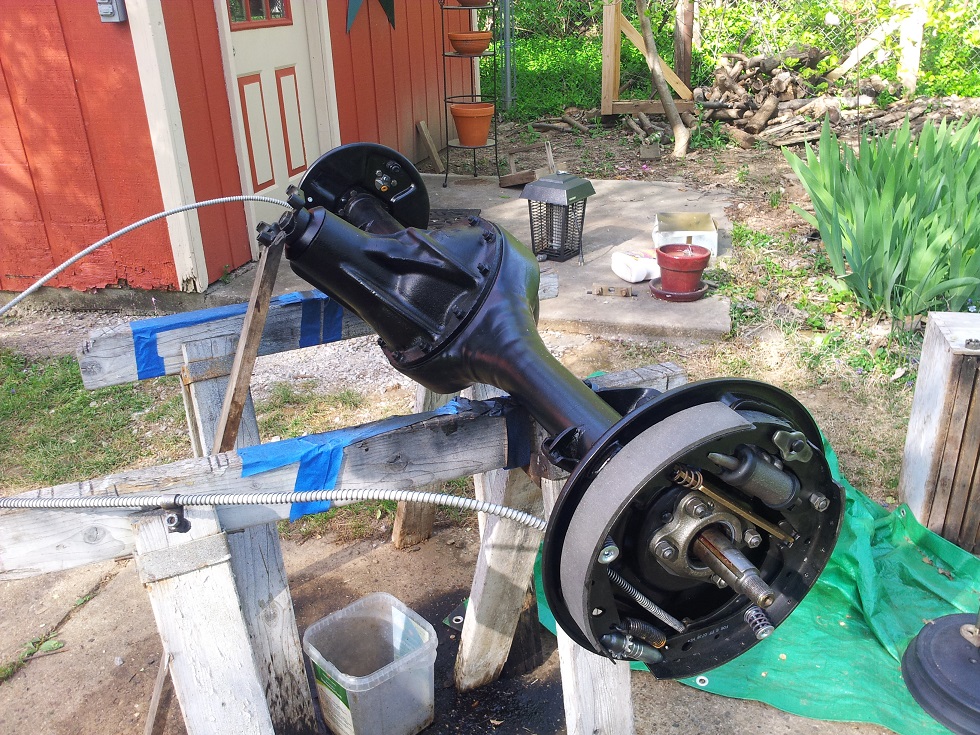
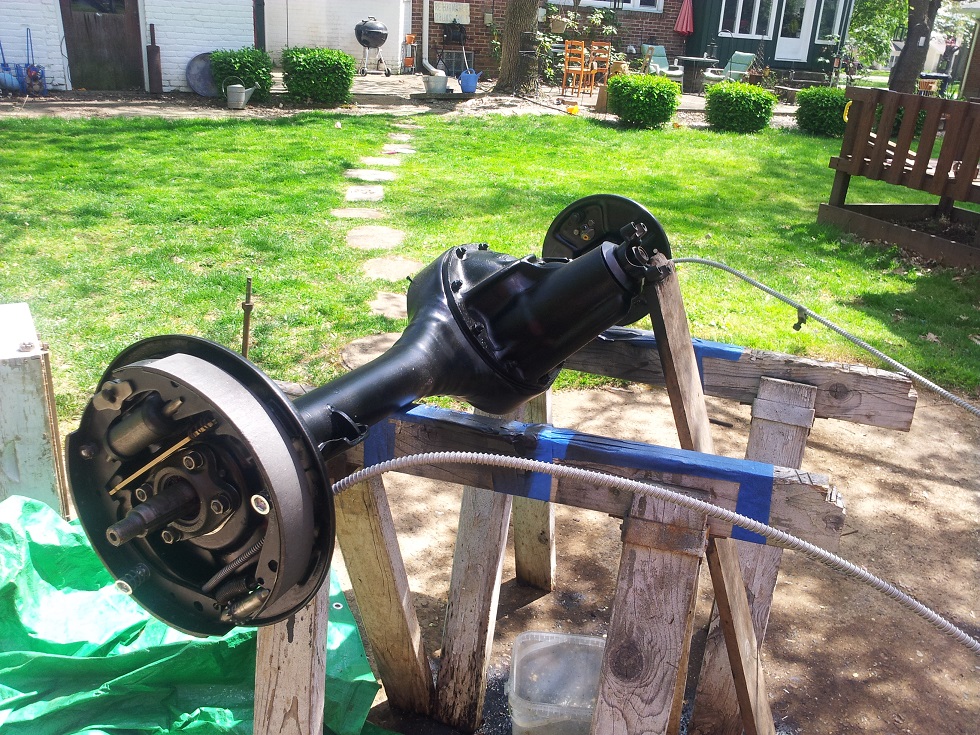
Thanks
-Ray
