

Should I change out my front motor mounts on my 48 Commodore? The original ones look like smushed mushrooms. Would there be less vibration and a quieter ride with new mounts? Is this worth doing?

Josh, I would change them out if not done before. You may or may not notice a difference but you dont want one to fail on you. I've never experienced a failure in the years I've been driving Hudsons. Some of the old timers on here who have had failures may chime in and share their experiences. You can get fresh mounts from Dale Cooper (513) 821-6200 or other vendors. I just know Dale has them and that's where I got mine from.
Doug
Josh, Check your PM
Here's what it looks like. Looks original, but toasted.
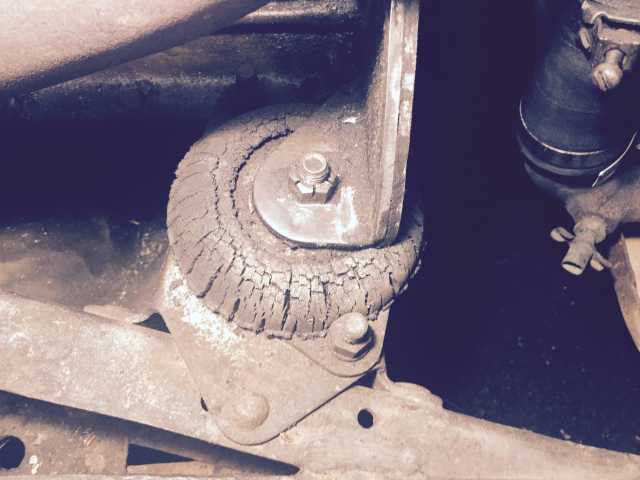

You will save the radiator by replacing, if not, on a quick emergency stop you will have to replace the radiator. The fan does a job on them. Walt.
Walt, thanks, that's all I need to know. I already read your method for replacing the mounts on the open forum.

I did a hard LH turn in the old 49 once and the mount came unglued. Motor flopped over against the right fender and yanked the throttle wide open. That was a little hairy until I got the key turned off. When I did my present 49, I used NAPA MM2280s. They have a metal keeper that will prevent separation if the glue (vulcanize) fails. Old Joe Harper used to say that gluein works, if ya use two screws.
Follow Walt's advice and replace them.

been there done that too!
Many thanks to all, I will replace the front mounts this weekend.
Now that I think it over, I have heard a slight metallic ticking on some fast stops, especially facing downhill. I thought it was a sound from the brakes, but now I think it is the edge of a fan blade slightly touching the lip of the upper radiator housing as the decayed mounts deform under stress. I'm glad I asked the question!

Josh
If the front motor mounts are that bad it might be a good idea to check the rear mount and drive shaft mount. When I bought my 52 Hornet the front mounts were mush, rear mounts for hydro and both driveshaft mounts were broken.
Lee O'Dell

Who is supplying the standard transmission mounts, these days?
Russ, I just went through this on my 52 Hornet driving from IL to AL. I thought my clutch was going bad and turned out one of the drive shaft support rubber bushings had separated from its mounting. When I got to AL I reached under and grabbed the drive shaft and it flopped from side to side so I knew immediately what it was. It drove fine at interstate speed but taking off was, well not too smooth. I got mine from Metro Products via Rock Auto online, just the two replacement bushings were needed to rebuild the part. Doug
Thanks to the good advice and help found here, I changed motor mounts today. It took me 10 hours under the shade tree. It took awhile to free up the bolts for the original mounts, plus, I had to craft a suitable block for jacking the engine. Also, since I have never done this before, I took it nice and slow. I removed the radiator so there would be room to work.
As suggested, I did the mounts one at a time so that I wouldn't have to fight to get the motor back in the right place. I loosened the left side, but kept the bolts on, and while jacking let the engine slightly rotate so I could remove the right mount. After putting in the right mount, I lowered the engine and bolted the base of the mount to the frame, and put a nut on the top of the right mount but left it on top of the bolt. Then I removed the left side bolts and jacked the motor again, getting a little opposite rotation. Removed and replaced the left mount, lowered the motor a bit, put in the bolts, and slowly lowered the engine with the bolts aligning the mounts. Then tightened up everything, replaced radiator and coolant, and the job was done.
I went for a short test drive after dinner; the engine is now much quieter from inside the car. Plus, the noise of the fan touching the radiator housing on a fast downhill stop is gone. It was a good day!
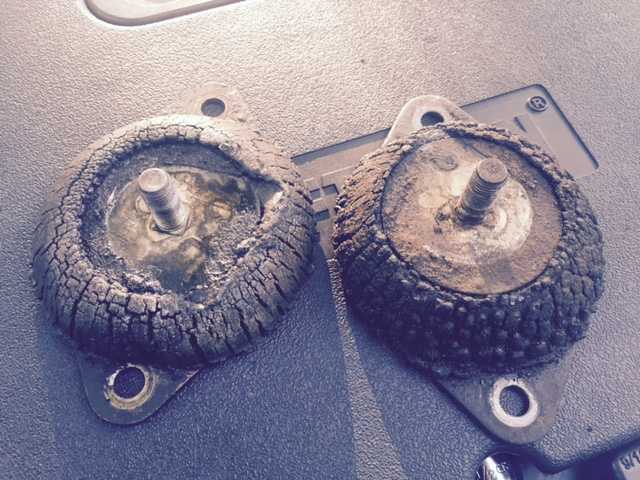
Here's what the old mounts looked like:
Thanks again for everyone's help with this. For anybody interested, Walt's method for changing out mounts is posted in the Open Forum.
Here's the photo:

Josh,
A great photo! Enough to make anyone with old mounts take a look at their condition!
Years ago I had a '36 Plymouth with Floating Power (Chrysler's name for rubber motor mounts). One time I stopped fast, luckily pushing the clutch down as I braked. The engine stopped, and then would not turn on the starter. I looked under the hood and saw that the fan was leaning on the radiator. Luckily it did not make a hole in the radiator. When I applied a tire iron to try and move the engine backwards, it easily glided back to its proper position. This car had a floor shift, so the movement of the engine did not affect shifting.
That experience helped me figure out a shifting problem on a '48 Plymouth. The car would not go into reverse when parked with the nose down on a steep hill. The engine moved forward enough so the column shift linkage got out of line. I learned to leave the car in reverse if I parked on a steep downhill, so if I needed to back up to get out of the space, I could do it.
Per
