
I am a recent owner (since August) of a 1949 Super Six sedan. I've never had a Hudson before, and it's been a pleasure to drive up around Napa which is where I mostly use the car.
I've sorted out all the mechanical problems (cooling was initially not up to the weather in Napa), and am at the point where I am trying to work through electrical. Main electrical works (spark, starting, driving lights), as well as things like the dash lights (but not the lamp in the roof).
The wiring appears to be somewhat stock from looking at the wiring diagram, but as this is my first Hudson it is difficult to be certain. Earlier today while driving it started making a loud ticking sound from under the dash. I narrowed it down to a small relay mounted above a metal arm above the steering column that I thought at first was the directional indicator but appears to be something else. It is definitely wired to ignition and the generator. The relay appears to be newer than the car (not surprising) but has no markings on it that I could otherwise see.
Ticking noise happens about every 5 seconds whenever the battery is plugged in (and I have at this point left it unplugged) regardless of the position of the ignition switch or whether the car is running.
I spent some time today with electrical cleaner going through the under dash parts that seem to be related but that didn't change anything.
I freely admit I am miles worse with electrical than with mechanical issues. Any ideas would be appreciated, including whether this is a standard part that I can source locally or is a part specific to Hudsons. I've attached a terrible picture.
Thanks in advance, John
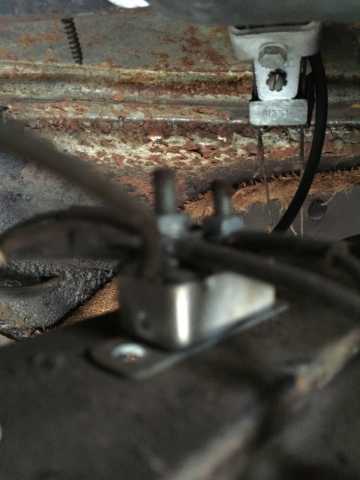

That is a circuit breaker, ticking means you have a short somewhere. Time for some detective work.

Above hit the nail right on the head. Start checking all wires that come off the circuit breaker. Start by snapping off the lens from the over dash light that you said does not work, as the fed wire stays alive and when you move the switch it sends juice to the bulb. Walt.

[size=5]ADDENDUM -- STOP THE PRESSES! Read my NEXT posting, before reading this one!
[/size]
You say this clicking happens even when the ignition switch is off. Nothing should be turned "on" at that point. So if there were a short circuit causing this clicking, it would NOT be happening between the switch and the component it controls (lights, heater, turn signal, ignition, etc.)
The "short" would only be happening in one of two places:
1) in the wire that "feeds" power to the breaker (presumably this would come from the voltage regulator. It might come from the ignition switch but you said that is turned off, in which case there'd be no clicking).
2) In the wire that runs from the circuit breaker to the switch that it feeds.
So, get a good light and get under the dash, and follow the wires connected to the breaker. Trace them. Chances are it will be easier to trace the wire from the breaker to the switch it feeds (on the dash), since it goes a short distance. The other wire -- bringing power to the breaker, will be harder to trace.
To troubleshoot THAT one, your task is simple: bypass it with a "good" wire to the voltage regulator and see if the clicking stops. Here's how: Disconnect the battery. Disconnect the one end of the suspect wire (going to the voltage regulator) from the breaker and tape it off (so it won't spark). Get a 10 foot length of new wire, and strip both ends. Connect one end to the breaker and the other to the battery terminal on the voltage regulator. (Just loop the new wire out the window, over the fender, and to the regulator; that's why you need a long length.) Re-connect the battery. The clicking should stop now because the suspected "bad" wire has been bypassed by a good one.
IF for some reason the clicking only happened when the headlight switch was on, that would be a different story. Hudson StepDowns were notorious for headlight breakers that turned your lights off, then on, then off, at night! If a former owner of your car experienced this, he may have replaced the breaker with a new one, and mounted the new one in the place where you found it. (Original position was on the headlight switch.) To verify that this happened, get under the dash and look at the headlight switch. Do you see a similar looking breaker there, but it's been disconnected? Well, there is proof that this happened.
Actually the former owner was treating the symptom, not the solution. The old circuit breaker was functioning just fine: it was trying to tell the former owner that there was a short circuit somewhere in the line. But his reaction was to get a new breaker, mount it under the dash, and re-route the headlight switch wiring to the new circuit breaker.
Which didn't solve the problem at all. The short circuit still existed. as witness the fact that the "new" breaker is still clicking.
If you find that this new breaker is connected to the headlights, it's an indication that the short circuit is probably located somewhere between either of the headlights or parking lights (or taillights, or dash lights for that matter) and the light switch. Only a few hundred feet of wire to check out, LOL!
One way to isolate the problem in that case, would be to disconnect each major headlight circuit as close to the switch as you can: the left headlight and parking light, then the right, then left taillight, then the right. (Oh, don't forget the dash lights too!) After disconnecting one circuit, turn the lights on. Does the breaker continue to click? Yes? Then disconnect the next circuit. Does it still click? When it stops clicking it means you've just disconnected the circuit with the problem.
Park Waldrop has pointed out that there IS a "main" circuit breaker in the StepDowns (I'm a "prehistoric Hudson" owner, and no such thing exists in the '37's!)
So, the breaker you found may be the "real deal" and not someone's add-on. And there is also a separate lighting circuit breaker, on the light switch.
In that case, please refer to a Hudson wiring diagram. Here's one on-line collection of diagrams by our friend Alex Burr, though you need to obtain a rail honest to gosh shop manual (original or reprint) if you intend to keep this car:
http://hetclub.org/burr/manuals/1946-1954_wiring_diagrams.pdf
Scroll down to the '49 diagram, and you'll find the "auxiliary circuit breaker" (not far from the "lighting circuit breaker" which is actually mounted to the light switch). This auxiliary breaker seems to be located just downstream from the voltage regulator and if I read it correctly it's supplying power to the brakelights and some of the domelight door switches, so you might try disconnecting them (one by one) from the breaker, to see if it still clicks. (The power to the headlights switch branches off the main terminal of the breaker, so I'm not sure that a short circuit in this particular wire would set off the breaker, but I'm no electrical engineer).

Troubles in the headlight wiring won't affect this breaker, since the headlight circuit is fed (purely for convenience) by the "power supply" terminal of the breaker, not the "protected" terminal.
Thanks for all the help. I got back in the car today to sort this out, and with the benefit of this advice and thinking about what can possibly stay on when the ignition is off was able to narrow the problem down to the dome light. And I'm glad I did, since the inside of the switch was extremely hot when I got the cover off. Since it hasn't ever worked in my ownership of the car, and looks pretty corroded, I just wrapped all the wires with electrical tape until I have time to fix it properly.
Ticking stopped.
Thanks again,
John
There you go, Walt hit the problem right on the head. From the way you describe, it had to be the dome light for when ignition switch is off only the dome light wire is alive. If it was the circuit breaker your headlights would go off and on. Walt.
primary circuit breaker. Glad you caught it before it started a fire!
Frankly, I think you're wise disconnecting the battery whenever you're away from the car. Even when you've gone over the wiring and think you have it in good shape. You just NEVER know...
They make switches for turning off the battery, though I have heard some people say that the "green knob" switches are really only good for 12 volt systems. Too much amperage in the 6-volt systems, and the switch contact point is very small.

Does anyone have a replacement part number & source for this circuit breaker? What is the correct amperage & does it make any difference if it is 6v or 12v?
thanks
J lombard

[quote="John Lynn" post=7922]Thanks for all the help. I got back in the car today to sort this out, and with the benefit of this advice and thinking about what can possibly stay on when the ignition is off was able to narrow the problem down to the dome light. And I'm glad I did, since the inside of the switch was extremely hot when I got the cover off. Since it hasn't ever worked in my ownership of the car, and looks pretty corroded, I just wrapped all the wires with electrical tape until I have time to fix it properly.
Ticking stopped.
Does your dome light work now?
The circuit breaker should have a voltage and amp rating on it.
[quote="J Lombard" post=11183]Does anyone have a replacement part number & source for this circuit breaker? What is the correct amperage & does it make any difference if it is 6v or 12v?
thanks
J lombard J, How many do you need?
Lance I need one to install & maybe one for a spare.
J
No problem J.

Jon and J,
The '51 6 volt Pacemaker in which Dan McNichol and I made several long trips from 2003 to 2008 had a "green button" cut-off switch on it when he bought it, and it worked fine for the 38,000 miles the car was driven before we transplanted its engine and transmission into the '49 Commodore sedan.
(He is presently making a cross-country trip in the '49 - put "ENR Low and Slow" into Google to see his route).
Electric power is calculated by volts times amperes (the unit of current). So for example if you need 48 watts of power, you can do it with 12 volts times 4 amperes equals 48 watts, or you can do it with 6 volts times 8 amperes equals 48 watts.
Current is what makes a connection get warm if the connection is not very good, or a wire get warm if it is too thin for the amount of current in it. In a 6 volt circuit, twice the current is needed for a certain amount of power compared with a 12 volt circuit, because the voltage is half as much. Because of this, wire needs to be thicker in 6 volt circuits than in 12 volt circuits. This is why people who have replaced the thick wire going to the starter with a wire designed for 12 volts (the wire is much thinner than the original wire but sometimes the plastic insulation is very thick, making the wire look thick) may have a slow turning starter, because some of the watts are used up warming the wire instead of turning the starter.
Per
